One access point for many models
Bring OpenAI, Azure OpenAI, Anthropic, Mistral, AWS Bedrock, and local models together behind one OpenAI-compatible API.
AI Gateway
Bring models, providers, and AI applications together through one control layer. Make cost, access, resilience, and compliance manageable across the entire company.
Companies increasingly use several AI models in parallel: one provider for internal assistants, another for development, and additional models for specialized tasks or sensitive data. Without central control, this creates individual API keys, unclear costs, inconsistent security rules, and unnecessary dependencies.
LiteLLM provides a central coordination layer for this entire AI usage. Applications and teams access different models and providers through one consistent entry point. Cost, access, quality, resilience, and compliance can be managed centrally without re-integrating every application whenever a provider changes.
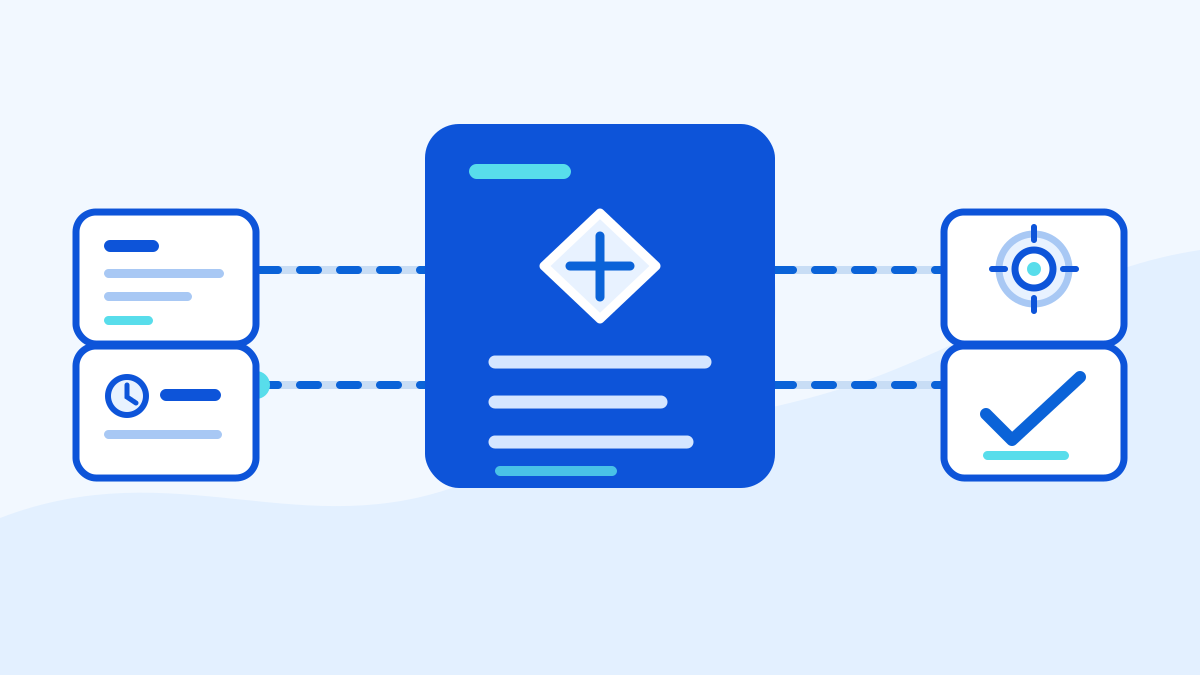
Teams, applications, and use cases access AI through one controlled entry point.
The central coordination layer for models, rules, and usage.
The right model is selected based on need, cost, and availability.
Bring OpenAI, Azure OpenAI, Anthropic, Mistral, AWS Bedrock, and local models together behind one OpenAI-compatible API.
Route requests by task, cost, latency, or availability and automatically switch to a defined alternative when a provider is unavailable.
Attribute API calls to teams, projects, or use cases and create a reliable basis for budgets and decisions.
Give teams controlled access through gateway keys with individual budgets, rate limits, and permissions.
Make usage, cost, latency, errors, and model behavior visible while creating traceable audit trails.
Combine content and data protection rules with self-hosted, cloud, or hybrid operations that fit your requirements.
The essential context for this solution at a glance.
These prompts show which decisions and reviews the solution can help teams prepare faster.
Management & platform leadership
The central layer makes AI usage controllable without blocking teams from accessing new models.
Finance & operations
Costs become visible where they occur. Budgets and limits reduce the risk of uncontrolled usage.
Engineering & business teams
Teams use one stable access point and choose models for the task without maintaining provider logic themselves.
The key perspectives, decisions, and control points behind the solution.
New AI models and applications are often introduced independently. Engineering, business teams, and innovation groups each choose the providers that fit their current use case best. This accelerates early results but quickly creates a landscape that is difficult to oversee in production.
Without central coordination, teams often lack reliable answers to basic questions: Which models are in use? Where does data flow? Which teams create costs? And how does an AI application stay available when one provider is down?
The LiteLLM Gateway sits between your applications and connected models. Applications use one stable access point. The gateway handles provider-specific connections, chooses routing based on defined rules, and records usage.
This creates one shared control point for the company's AI. New providers can be added, models exchanged, and budgets adjusted without rebuilding every application individually.
A typical mid-sized company starts with several AI applications and individual provider access. First, current usage is mapped by team, model, data type, and cost. A gateway is then deployed for one pilot team and connected to selected providers.
After fallback, load, and permission tests succeed, additional teams are migrated step by step. The result is shared infrastructure with visible costs, controlled access, and a clear operating model.
LiteLLM combines a consistent developer experience with the flexibility of a multi-provider strategy. The central access point reduces individual integrations and creates a shared foundation for governance, monitoring, and cost optimization.
The concrete configuration should not follow a rigid template. Providers, routing, budgets, and operations are tailored to your data, use cases, and organizational responsibilities.
The workflow breaks into clear steps — from the first source to controlled use in the business process.
Start by mapping applications, teams, providers, models, data types, and costs. This creates a model and use-case matrix for architecture and prioritization.
Deploy the gateway as a controlled infrastructure component, for example as a container in your own cloud or on-premise environment. Network, secrets, TLS, scaling, and backups are configured for the selected operating model.
Connected models are defined with clear aliases and routing rules. Requests can be routed by cost, latency, complexity, region, or availability depending on the use case.
Teams and applications receive controlled gateway keys. Budgets, rate limits, and roles keep responsibilities visible and prevent usage from silently exceeding expectations.
Existing applications are moved step by step to the gateway address and approved model aliases. The rollout starts with a limited use case before further teams and production workloads are migrated.
After rollout, dashboards, alerts, audit logs, and an operations runbook are established. Regular reviews check cost, quality, security rules, and the provider strategy.
| Area | Before | With gateway |
|---|---|---|
| Access | Each team uses its own provider keys and integrations. | All applications access models through one centrally managed gateway. |
| Cost | Separate invoices and unclear allocation by team or project. | Spend tracking, budgets, and limits create ongoing transparency. |
| Provider changes | SDKs, configuration, and application code need to be adapted. | Routing rules and model assignments change centrally. |
| Resilience | One provider outage can block an entire AI capability. | Fallbacks and load balancing keep suitable alternatives available. |
Views into usage, cost, risk, and provider dependencies
Providers, models, routing rules, limits, and operations
Budgets, cost allocation, alerts, and team/project reporting
Approved models and gateway keys for applications and agents
Controlled access to approved AI applications and use cases
LiteLLM is an open-source gateway that brings different LLM providers together through one central, OpenAI-compatible access point. Applications talk to the gateway while routing, access, and provider details are managed centrally.
Yes. LiteLLM can run as a containerized component in your own infrastructure, in a European cloud, or as part of a hybrid architecture. The operating model should match your data protection, availability, and operations requirements.
In many cases, existing OpenAI-compatible usage can remain in place and the application only needs to point to the gateway base URL. The actual effort depends on current integrations, credentials, and governance requirements.
Typical options include OpenAI, Azure OpenAI, Anthropic, Mistral, AWS Bedrock, Google Vertex AI, and local models. The provider matrix should be defined around your use cases, data requirements, and cost structure.
No. The gateway provides a central control layer while making model choice more flexible. Models can be routed by use case, cost, latency, data protection, or availability and exchanged without a structural application rewrite.
An AI Gateway turns many individual AI access points into a manageable company infrastructure. LiteLLM brings models and providers together, makes usage and cost transparent, and gives platform and business teams a shared framework for innovation.
The core value is central coordination: companies can adopt new models faster, change providers flexibly, absorb outages, and enforce rules for privacy, budgets, and access in one place.
Explore other use cases that can connect with this solution.